So I've been using a Motorola Tri-band GSM phone I bought two years ago in Beijing. The main reason I bought it was so that I could use it in other countries -- simply swapping SIM chips in and out of it whenever I go to new countries. I've now collected SIM chips from China, India, South Africa, and now Peru.
Unfortunately, in all the aforementioned countries (with the notable exception of China), using cell phones is prohibitively expensive. As a result, most people send short text messages, which are far cheaper. An additional bonus to text messages, especially when service is a bit dodgy, is that communication is always clear. No constant "what? what?" as the other person descends into static.
I had already blown through about $10 USD worth of cell phone credit in my first week in Peru, so I tried to send mostly text messages. Unfortunately, I began to realize that my text messages were not sending when nobody was replying -- I checked the status of about ten text messages and saw that it just said "sending in progress." I was able to receive text messages but not able to send them. I gave up on text messages for the next couple weeks in Lima.
After turning off my cell phone during my time in Huaraz, and coming back to Lima, my cell phone magically discovered how to send text messages. As a result, about ten text messages were sent all at once, their contents no longer relevant. Examples:
"Good I'm in front of the office waiting for you"
"Dinner? I'm interested in the Quito move" (a response to a friend that had contemplated moving to Quito, Ecuador)
"Are we going to meet in the school?"
"Come to Miraflores for ceviche"
"I'm on Avenida la Marina I'm coming now"
"What was the name of the place we went to last night and where is it?"
As you may suspect, these messages were no longer relevant three or four weeks after I had originally intended to send them.
The replies I got were funny:
One called me three times before sending me an email asking me why I was bothering them.
Another responded "it's called Sargeant Pepper's let's go tonight" (in response to the last text; I know for a fact it was not Sargeant Pepper's, but I appreciated the reply regardless)
To "Let's meet at the school," the response was a curt, "I'm at work."
Showing posts with label Lima. Show all posts
Showing posts with label Lima. Show all posts
Monday, August 18, 2008


Friday, August 8, 2008
A few photos
So I realize that I haven't posted any photos of Chinatown streets or the big gate here in Lima. Part of the reason why I haven't is because those kinds of photos are readily available on the internet, and my photographic contributions aren't new or original. But maybe I've been spoiled, because I get to see these streets everyday.


Vegetable market

Calle Capon, the main drag:


Vegetable market

Calle Capon, the main drag:


Saturday, August 2, 2008
Panyu Ancestral Temple 番禹会馆 Lima, Peru
Continuing on the same theme of "ancestral temples" as the previous post, I had a chance to attend another temple gathering within Barrio Chino. This was at the Panyu temple, which is supposedly based around clans and kinships from Guangzhou City (广州市).
This gathering was held on Monday, the day before Peruvian independence. A lion dance was held outside and made its way inside.


Throughout a hallway and within a special room were photos of the original immigrants from Guangzhou.


This gathering was held on Monday, the day before Peruvian independence. A lion dance was held outside and made its way inside.


Throughout a hallway and within a special room were photos of the original immigrants from Guangzhou.


Tuesday, July 29, 2008
Tung Sing, Ancestral temple in Barrio Chino, Lima
Tung Sing (同型, Mandarin: Tong Xing is a temple near Barrio Chino, in the Central Market area of Lima. Barrio Chino is essentially a series of streets in the middle of the Central Market, and the concentration of Chifas (Chinese restaurants) and businesses peters out as one walks further from the main drag of the Calle Capon street and the perpendicular Jiron Paruro street.
The temple is not visible from the street, it is tucked behind a nondescript alleyway, and its main facade is facing away from the street.
The temple is mainly used by immigrants and descendants from Zhongshan (中山), an area in Guangdong province. It seems as if most Chinese here are from Zhongshan, and to a lesser extent, from Taishan county (where my mother's family is from), Guangzhou city, and Nanhai.


In the corner is German Koo, the "priest" of the temple. Apparently he has some sort of qualifications, but I am told by Chinatown residents that he is quite a greedy character. Indeed, he immediately asked for a donation upon my arrival in the temple.


Photos of Sun Yat-sen, considered one of the founding fathers of modern China, are popular in El Barrio Chino. Actually, Zhongshan was named after Sun Yat-sen (who's name in pinyin is Sun Zhongshan).
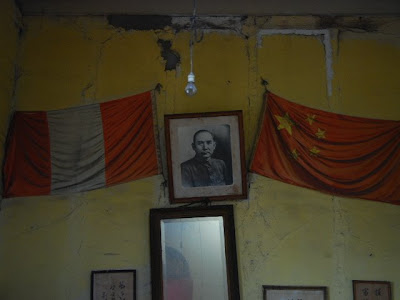


The temple is not visible from the street, it is tucked behind a nondescript alleyway, and its main facade is facing away from the street.
The temple is mainly used by immigrants and descendants from Zhongshan (中山), an area in Guangdong province. It seems as if most Chinese here are from Zhongshan, and to a lesser extent, from Taishan county (where my mother's family is from), Guangzhou city, and Nanhai.


In the corner is German Koo, the "priest" of the temple. Apparently he has some sort of qualifications, but I am told by Chinatown residents that he is quite a greedy character. Indeed, he immediately asked for a donation upon my arrival in the temple.


Photos of Sun Yat-sen, considered one of the founding fathers of modern China, are popular in El Barrio Chino. Actually, Zhongshan was named after Sun Yat-sen (who's name in pinyin is Sun Zhongshan).


Monday, July 28, 2008
Snakes in a market
Since I've told this story to a couple of people now, I may as well repeat it here:
There's a little alleyway off the main street in El Barrio Chino, quite shady in both senses of the word. The alleyway serves as a produce market where one can get all sorts of Chinese vegetables, including (as I've mentioned earlier) my favorite kongxincai. They also have excellent, fresh tofu made daily (although it usually sells out by 3 pm), and sometimes fish in the mornings. There's also a fruit vendor, from whom I buy kiwis, and who I will talk about later in this blog.
I was talking with the fruit vendor last Tuesday, when some guy starts pulling out this long, taut, but slightly curled thing from a large rice sack. It keeps coming out, and three guys join in to pull the thing out. People start murmuring in the market, when they realize it's a giant boa constrictor. The guys seem to inspect it for a while (I was maybe 20 meters away -- no pictures, sorry), before putting it back into the rice sack and leaving it near the entrance of the alleyway market, on the ground.
As I walk out, I notice that there are a couple more rice sacks with the boa constrictor sack, lying haphazardly on the ground, their contents unknown.
There's a little alleyway off the main street in El Barrio Chino, quite shady in both senses of the word. The alleyway serves as a produce market where one can get all sorts of Chinese vegetables, including (as I've mentioned earlier) my favorite kongxincai. They also have excellent, fresh tofu made daily (although it usually sells out by 3 pm), and sometimes fish in the mornings. There's also a fruit vendor, from whom I buy kiwis, and who I will talk about later in this blog.
I was talking with the fruit vendor last Tuesday, when some guy starts pulling out this long, taut, but slightly curled thing from a large rice sack. It keeps coming out, and three guys join in to pull the thing out. People start murmuring in the market, when they realize it's a giant boa constrictor. The guys seem to inspect it for a while (I was maybe 20 meters away -- no pictures, sorry), before putting it back into the rice sack and leaving it near the entrance of the alleyway market, on the ground.
As I walk out, I notice that there are a couple more rice sacks with the boa constrictor sack, lying haphazardly on the ground, their contents unknown.
Wednesday, July 16, 2008
请客 (qing'ke), or, the art of invitation
It is one of the first lessons in college-level Chinese, something described as an indispensable part of Chinese culture, and something I actually attempted to describe in my fellowship interview. My concise Oxford University Press Chinese-English dictionary defines "qing ke" as the following:
"stand treat; entertain guests; give a dinner party; play the host."
I think I described it in my Watson interview when posed the question, how exactly are you actually gonna get to know all these Chinese people? I tried to describe how during my times in China, as well as with my family back home in the U.S., relationships are made and cemented through "qing ke." Basically, one asks another (or a group of people) for a lunch, a cup of tea, a beer, or really any other social activity. I'm not well versed in the specifics, but I'm pretty sure some sort of monetary exchange is necessary, in order to demonstrate that one is actually treating the other person (So, inviting someone for a walk in the park doesn't count, but paying for the post-walk teahouse does). When the bill eventually comes, the appropriate parties spend a good amount of time fighting over the bill. If one is particularly determined to treat, he or she makes prior arrangements (with the restaurant staff, for instance) so the bill doesn't slip into the wrong hands.
Of course, once one has treated another, it is the guest's unspoken duty to treat the host the next time.
I should mention that I tried to "qing'ke" the second day in Lima, with a chain-smoking Tianjin guy with stained yellow teeth, a leather jacket, and a thick Northerner accent (which stands out against the Cantonese-inflected Mandarin that most others speak here). It was like I was in Beijing all over again -- visitors of the Chinese capital have probably all noticed the large groups of such men in restaurants rowdily downing beer after beer, shirts rolled up and faces red, cigarette stumps littered across the floor. After noting we were living in the same neighborhood, I invited him out for a beer, as befits this seemingly stereotypical northerner. He politely agreed, but nothing ever came of it, and for some odd reason, I haven't seen him in his shop since that first day.
It's now been nearly two weeks since I got here, and I finally had my first two "qing'ke" exchanges in the past three days. I failed to pay both times, perhaps reflecting my novice bill-fighting abilities. I would like to note that I was also quite clearly playing against a home-field advantage: the first time, it was the restaurant owner who was treating me. I tried to force the ten soles bill (about $3.40) into her hands, but it simply wouldn't take. It's amazing. I tried a couple times, but she refused and simply said "next time."
The second time happened today. Roxane, who I think I mentioned in a previous post, invited me and her son (who is the same age) out for lunch at Chifa Canton. The food was delicious, a great vegetable dish with my favorite mu'er, a fungus literally translated as "tree ears," and a local fish steamed in classic Cantonese style with a healthy amount of ginger and scallions. I kept thinking, there is no way I can let her pay for this. Unbeknownst to me, however, Roxane had apparently made previous arrangements with the restaurant owner (who is her good friend) to pay for the lunch, so when I asked for the bill, they said it had already been paid. Even worse, Roxane had slipped out to work, so I couldn't even fight with her for the bill.
But I think that these two "qing'ke" incidents are good signs. They may have treated me this time, but no matter how much they fight for the bill next time, eventually I'll win, and I'll pay. It's an unspoken rule. And it signifies that at the very least, a kind of personal relationship is forming.
"stand treat; entertain guests; give a dinner party; play the host."
I think I described it in my Watson interview when posed the question, how exactly are you actually gonna get to know all these Chinese people? I tried to describe how during my times in China, as well as with my family back home in the U.S., relationships are made and cemented through "qing ke." Basically, one asks another (or a group of people) for a lunch, a cup of tea, a beer, or really any other social activity. I'm not well versed in the specifics, but I'm pretty sure some sort of monetary exchange is necessary, in order to demonstrate that one is actually treating the other person (So, inviting someone for a walk in the park doesn't count, but paying for the post-walk teahouse does). When the bill eventually comes, the appropriate parties spend a good amount of time fighting over the bill. If one is particularly determined to treat, he or she makes prior arrangements (with the restaurant staff, for instance) so the bill doesn't slip into the wrong hands.
Of course, once one has treated another, it is the guest's unspoken duty to treat the host the next time.
I should mention that I tried to "qing'ke" the second day in Lima, with a chain-smoking Tianjin guy with stained yellow teeth, a leather jacket, and a thick Northerner accent (which stands out against the Cantonese-inflected Mandarin that most others speak here). It was like I was in Beijing all over again -- visitors of the Chinese capital have probably all noticed the large groups of such men in restaurants rowdily downing beer after beer, shirts rolled up and faces red, cigarette stumps littered across the floor. After noting we were living in the same neighborhood, I invited him out for a beer, as befits this seemingly stereotypical northerner. He politely agreed, but nothing ever came of it, and for some odd reason, I haven't seen him in his shop since that first day.
It's now been nearly two weeks since I got here, and I finally had my first two "qing'ke" exchanges in the past three days. I failed to pay both times, perhaps reflecting my novice bill-fighting abilities. I would like to note that I was also quite clearly playing against a home-field advantage: the first time, it was the restaurant owner who was treating me. I tried to force the ten soles bill (about $3.40) into her hands, but it simply wouldn't take. It's amazing. I tried a couple times, but she refused and simply said "next time."
The second time happened today. Roxane, who I think I mentioned in a previous post, invited me and her son (who is the same age) out for lunch at Chifa Canton. The food was delicious, a great vegetable dish with my favorite mu'er, a fungus literally translated as "tree ears," and a local fish steamed in classic Cantonese style with a healthy amount of ginger and scallions. I kept thinking, there is no way I can let her pay for this. Unbeknownst to me, however, Roxane had apparently made previous arrangements with the restaurant owner (who is her good friend) to pay for the lunch, so when I asked for the bill, they said it had already been paid. Even worse, Roxane had slipped out to work, so I couldn't even fight with her for the bill.
But I think that these two "qing'ke" incidents are good signs. They may have treated me this time, but no matter how much they fight for the bill next time, eventually I'll win, and I'll pay. It's an unspoken rule. And it signifies that at the very least, a kind of personal relationship is forming.
Monday, July 14, 2008
Food in Lima
Food in Lima has been great. I was expecting to cook a lot more, but with such delicious and relatively inexpensive food everywhere, I've been eating out quite often. I often eat Chifa, Peruvian-Chinese food, in Chinatown or elsewhere. Someone quoted that there were approximately 4,000 Chifas in all of Lima, quite a large amount, even taking into account Lima's size (estimated population of 8 million, about a third of Peru's total population!).
Limenos (Lima residents), it appears, are carnivores, and it's difficult to order dishes that feature vegetables and not meat. Most of the Chifa menu items are quite meaty, which can get overwhelming at times. Because I'm a cheapskate and because I normally eat by myself, I order off the "El Menu," which is basically a set-price, 2 or 3 course meal. Chifas usually have a "sopa wanton" and a main dish, such as "pollo tamarindo," chicken in tamarind sauce, and maybe a small desert or drink if you get the "menu ejecutivo." This all costs about 6-9 soles, or about 2-3 dollars.
I've also been able to get a good variety of Chinese vegetables in a sidestreet market in the Chinatown here. They even have kongxincai (literally translated as "open-heart vegetable... the stalks are hollow), my favorite Chinese vegetable. I bought some homemade tofu today as well, and it was quite delicious.
When people ask me what I eat here, the other thing I usually mention besides chifa is ceviche-- raw seafood-- which is famous in Peru. The fish ceviche is the classic dish and my favorite, although the conchas negras (black clam) ceviche is also delicious. Its normally served dunked in lime juice and with red onions, as well as corn and sweet potato on the side. All told, I'm quite happy with the food here!
Limenos (Lima residents), it appears, are carnivores, and it's difficult to order dishes that feature vegetables and not meat. Most of the Chifa menu items are quite meaty, which can get overwhelming at times. Because I'm a cheapskate and because I normally eat by myself, I order off the "El Menu," which is basically a set-price, 2 or 3 course meal. Chifas usually have a "sopa wanton" and a main dish, such as "pollo tamarindo," chicken in tamarind sauce, and maybe a small desert or drink if you get the "menu ejecutivo." This all costs about 6-9 soles, or about 2-3 dollars.
I've also been able to get a good variety of Chinese vegetables in a sidestreet market in the Chinatown here. They even have kongxincai (literally translated as "open-heart vegetable... the stalks are hollow), my favorite Chinese vegetable. I bought some homemade tofu today as well, and it was quite delicious.
When people ask me what I eat here, the other thing I usually mention besides chifa is ceviche-- raw seafood-- which is famous in Peru. The fish ceviche is the classic dish and my favorite, although the conchas negras (black clam) ceviche is also delicious. Its normally served dunked in lime juice and with red onions, as well as corn and sweet potato on the side. All told, I'm quite happy with the food here!
Thursday, July 10, 2008
An introduction to El Barrio Chino in Lima, Peru
"Chifa" is the word used to describe Chinese food in Peruvian Spanish, a slight corruption of the Chinese compound chi-fan, literally translated as "Eat Food." Chifa seems to be ubiquitous in Lima, even outside the Chinatown area. In my district, Miraflores, there are two Chifas only two minutes away from my apartment building. It appears as if the Chinese influence in Peru has at least permeated its cuisine, and foods such as sopa wanton and chaufa (fried rice) are found everywhere. Often after attempting to explain my project to Peruvians, I ask them if they've had Chifa, and if so, if they like it. I have yet to meet a single Peruvian (or more specifically, someone from Lima) who isn't aware of the Chinese population here, or who hasn't tried Chinese food. They have all said that they like it, but that may be a different matter.
The Chinese have settled in Peru for over hundred years, and continue to do so today. Lima's Chinatown is one of the most established in the Western Hemisphere, and is perhaps the most famous Chinatown outside of the United States. Geographically, however, "El Barrio Chino" (the Chinatown) is quite small -- it is composed of only two perpendicular streets, Calle Uyacali and Calle Capon.
I arrived in Lima one week ago, and I quickly obesrved that the Chinese community here in Peru isn't really a unified entity. Similar to the Chinese community in, say, New York, the Chinese community in Lima is an eclectic mix of recent immigrants, first-generation Chinese (such as myself), and descendants of Chinese immigrants who arrived here as early as the mid-1800s.
Cantonese immigrants were the first settlers in Peru. Many of their descendants are already well-integrated into Peruvian society, no longer speak Cantonese, and seem to separate themselves from the more recent immigrants. These different groups don't necessarily interact on equal terms, either.
Roxane Lok, who works at a foodstuffs store, arrived from Guangdong less than ten years ago. She was friendly with me on my first day in Barrio Chino, and was willing to pose for a photograph with her boss, Julia, a Peruvian-born woman of Chinese descent, called tusan, another Peruvian Spanish term that is derived from the Chinese tusheng, or locally-born.
Roxane appeared quite aware of the disparities between these two groups. I asked the two where they live, and Julia replied San Isidro, a posh suburb where private guards and electric fences are the norm; whereas Roxane replied El Barrio Chino, which despite its touristy veneer, is the first stop for many newly-arrived immigrants. Roxane simplified the difference between these two groups as symbolic of her relationship with Julia, "La duena y la trabajadora" (The Boss and The Worker).
Most recent immigrants have also arrived from Guangdong, but many more have come from another southern coastal province that has historically sent many immigrants abroad, Fujian. Mr. Lu, an acupuncturist in the Barrio Chino, estimates that within the past eight years the Fujianese population here expanded from only 200 to over 5,000. I don't know whether that is true, but many of the new Chifas that are popping up around the two main streets of the Barrio Chino are run by Fujianese.
Mr. Lu
Mr. Lu, however, does not fit into either of the two predominant categories of Chinese here; he is neither a part of the recent migration from the southern provinces nor is he a descendant of early settlers. Mr. Lu is from Shanghai, and at the age of fifty-five, he managed to get a visa out of China in 1987 (do the math... I did). Unlike most of the other Chinese here, too, Mr. Lu seems enamored of his adopted country and highly critical of his country of birth.
Mr. Lu almost immediately began describing to me the great freedoms he had in Peru, that although China's economy has opened up, its government still hasn't, and that the Chinese are all after money whereas the Peruvians are much more humane. More than once, Mr. Lu grandly described the "libertad" in Peru, which he asserted was near-absent in China.
Mr. Lu's age already hinted at the fact that he undoubtedly lived through some of the most traumatic periods in Chinese history -- the Great Proletarian Cultural Revolution during the 1960s and 1970s. Mr. Lu's iconoclastic comments further contributed to a suspicion that he must have endured unspeakable hardships in China. One common theme that will undoubtedly run through this project is attempting to understand why people left China, and perhaps more historically, under what conditions they left.
Because of my thesis work on China's barefoot doctors (Chijiao yisheng) during the Cultural Revolution, I was interested in whether Mr. Lu had trained any doctors, since he had already finished medical school (in Chinese medicine) by 1961, at the Medical University in Anhui province. While writing my thesis, I learned that China was able to rapidly train over 1.5 million "barefoot doctors" -- minimally trained rural paramedics -- largely through the help of forced rural conscription of urban doctors.
He said that he was "sent down" (xiaxiang) to the countryside in the late 1960s, which was quite common for urban residents with the wrong politics, and yes, he trained many barefoot doctors in rural Anhui, as well as "worker's doctors" (gongren yisheng) outside of Shanghai. During the Cultural Revolution many political undesirables -- intellectuals, "capitalist roaders," teachers, doctors -- were forcibly sent to the countryside to engage in grueling manual labor.
Mr. Lu also indicated that he would not have been able to go to medical school later on, because as he put it, his parents had a "hacienda." The nice thing about talking with these Chinese-Peruvians is that when my Chinese fails (i.e., I had forgotten had to say "landowners" in Chinese), we can often switch to Spanish. Both Chinese and Spanish are currently occupying the very small space my brain has allocated for foreign languages, so mixing up the two is inevitable. Back to the Hacienda. Shortly after Mr. Lu must have entered medical school in 1957, class struggles would have made it impossible for Mr. Lu, the son of landowners, to attend a medical school. On the other hand, those who had grown up as peasants or landless laborers would have had a far greater chance at higher education.
Mr. Lu is spritely and in good spirits at 75, and seems to have adapted to Lima quite well. He has a Peruvian wife and his three children (I assume from a previous marriage in China) are scattered across the world -- one in Canada, one in China, and one practicing acupuncture in you guessed it, Cote d'Ivoire. I told him that this was a little strange, going to Cote d'Ivoire, and he goes "Yes, it's hard there, but it's still good."
The Chinese have settled in Peru for over hundred years, and continue to do so today. Lima's Chinatown is one of the most established in the Western Hemisphere, and is perhaps the most famous Chinatown outside of the United States. Geographically, however, "El Barrio Chino" (the Chinatown) is quite small -- it is composed of only two perpendicular streets, Calle Uyacali and Calle Capon.
I arrived in Lima one week ago, and I quickly obesrved that the Chinese community here in Peru isn't really a unified entity. Similar to the Chinese community in, say, New York, the Chinese community in Lima is an eclectic mix of recent immigrants, first-generation Chinese (such as myself), and descendants of Chinese immigrants who arrived here as early as the mid-1800s.
Cantonese immigrants were the first settlers in Peru. Many of their descendants are already well-integrated into Peruvian society, no longer speak Cantonese, and seem to separate themselves from the more recent immigrants. These different groups don't necessarily interact on equal terms, either.
Roxane Lok, who works at a foodstuffs store, arrived from Guangdong less than ten years ago. She was friendly with me on my first day in Barrio Chino, and was willing to pose for a photograph with her boss, Julia, a Peruvian-born woman of Chinese descent, called tusan, another Peruvian Spanish term that is derived from the Chinese tusheng, or locally-born.
Roxane appeared quite aware of the disparities between these two groups. I asked the two where they live, and Julia replied San Isidro, a posh suburb where private guards and electric fences are the norm; whereas Roxane replied El Barrio Chino, which despite its touristy veneer, is the first stop for many newly-arrived immigrants. Roxane simplified the difference between these two groups as symbolic of her relationship with Julia, "La duena y la trabajadora" (The Boss and The Worker).
Most recent immigrants have also arrived from Guangdong, but many more have come from another southern coastal province that has historically sent many immigrants abroad, Fujian. Mr. Lu, an acupuncturist in the Barrio Chino, estimates that within the past eight years the Fujianese population here expanded from only 200 to over 5,000. I don't know whether that is true, but many of the new Chifas that are popping up around the two main streets of the Barrio Chino are run by Fujianese.
Mr. Lu
Mr. Lu, however, does not fit into either of the two predominant categories of Chinese here; he is neither a part of the recent migration from the southern provinces nor is he a descendant of early settlers. Mr. Lu is from Shanghai, and at the age of fifty-five, he managed to get a visa out of China in 1987 (do the math... I did). Unlike most of the other Chinese here, too, Mr. Lu seems enamored of his adopted country and highly critical of his country of birth.
Mr. Lu almost immediately began describing to me the great freedoms he had in Peru, that although China's economy has opened up, its government still hasn't, and that the Chinese are all after money whereas the Peruvians are much more humane. More than once, Mr. Lu grandly described the "libertad" in Peru, which he asserted was near-absent in China.
Mr. Lu's age already hinted at the fact that he undoubtedly lived through some of the most traumatic periods in Chinese history -- the Great Proletarian Cultural Revolution during the 1960s and 1970s. Mr. Lu's iconoclastic comments further contributed to a suspicion that he must have endured unspeakable hardships in China. One common theme that will undoubtedly run through this project is attempting to understand why people left China, and perhaps more historically, under what conditions they left.
Because of my thesis work on China's barefoot doctors (Chijiao yisheng) during the Cultural Revolution, I was interested in whether Mr. Lu had trained any doctors, since he had already finished medical school (in Chinese medicine) by 1961, at the Medical University in Anhui province. While writing my thesis, I learned that China was able to rapidly train over 1.5 million "barefoot doctors" -- minimally trained rural paramedics -- largely through the help of forced rural conscription of urban doctors.
He said that he was "sent down" (xiaxiang) to the countryside in the late 1960s, which was quite common for urban residents with the wrong politics, and yes, he trained many barefoot doctors in rural Anhui, as well as "worker's doctors" (gongren yisheng) outside of Shanghai. During the Cultural Revolution many political undesirables -- intellectuals, "capitalist roaders," teachers, doctors -- were forcibly sent to the countryside to engage in grueling manual labor.
Mr. Lu also indicated that he would not have been able to go to medical school later on, because as he put it, his parents had a "hacienda." The nice thing about talking with these Chinese-Peruvians is that when my Chinese fails (i.e., I had forgotten had to say "landowners" in Chinese), we can often switch to Spanish. Both Chinese and Spanish are currently occupying the very small space my brain has allocated for foreign languages, so mixing up the two is inevitable. Back to the Hacienda. Shortly after Mr. Lu must have entered medical school in 1957, class struggles would have made it impossible for Mr. Lu, the son of landowners, to attend a medical school. On the other hand, those who had grown up as peasants or landless laborers would have had a far greater chance at higher education.
Mr. Lu is spritely and in good spirits at 75, and seems to have adapted to Lima quite well. He has a Peruvian wife and his three children (I assume from a previous marriage in China) are scattered across the world -- one in Canada, one in China, and one practicing acupuncture in you guessed it, Cote d'Ivoire. I told him that this was a little strange, going to Cote d'Ivoire, and he goes "Yes, it's hard there, but it's still good."
Subscribe to:
Posts (Atom)
