I just posted on a friend's blog with photos from China, of a near-empty village where many people have moved to Brazil and the United States. I've posted there mainly because the readership of Mauricio's blog is largely Brazilian (Mauricio is from Sao Paulo), and I haven't figured out how to cross-post it onto my blog.
The link is here:
Aqui e Acola: Things they left behind
Showing posts with label china. Show all posts
Showing posts with label china. Show all posts
Monday, May 25, 2009


Saturday, May 9, 2009
B&W photos from Taishan
Black and White photos from Taishan county.

 Women sort through a pile of mud in order to find baby crabs, which they then sell to a man at 100 crabs/20 RMB (a little less than $3 USD). The guy then either sells the crabs or raises them until they are big and he sells them for a crabload. We got our full-size crabs for 45 RMB, about $7 USD.
For two nights, I stayed in Sha-Lan village, which has recently seen a large emigration to Brazil. Indeed, two of the families I met in Brazil hailed from this village, and I was able to contact their families to see their homes they left behind.

The family I stayed with had a son who was 19, and was quite severely mentally retarded. He acted like a 3 or 4 year old, crying when he didn't get something, pouting to his mom, and woke up everyone at 5 am for no reason. He seemed to love photography; I allowed him to take my photo and he loved it when I took his. At one point, he ran to his older sister's room and grabbed her Hello Kitty. I like the picture for some reason.
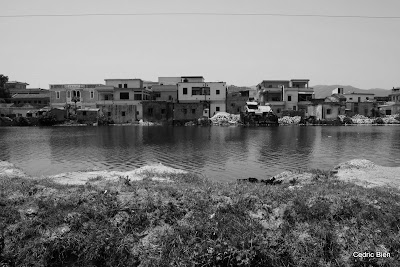 Sha-Lan village.
 Sha-Lan village

 Women sort through a pile of mud in order to find baby crabs, which they then sell to a man at 100 crabs/20 RMB (a little less than $3 USD). The guy then either sells the crabs or raises them until they are big and he sells them for a crabload. We got our full-size crabs for 45 RMB, about $7 USD.
For two nights, I stayed in Sha-Lan village, which has recently seen a large emigration to Brazil. Indeed, two of the families I met in Brazil hailed from this village, and I was able to contact their families to see their homes they left behind.
 The family I stayed with had a son who was 19, and was quite severely mentally retarded. He acted like a 3 or 4 year old, crying when he didn't get something, pouting to his mom, and woke up everyone at 5 am for no reason. He seemed to love photography; I allowed him to take my photo and he loved it when I took his. At one point, he ran to his older sister's room and grabbed her Hello Kitty. I like the picture for some reason.
 Sha-Lan village.
 Sha-Lan village
Taishan, the roots of the diaspora
 The above photo is of my maternal grandfather's village in Haiyan, literally "Sea Banquet." We had seafood everyday. One meal I counted a total of eight different kinds of fish.
Side note: Blogger has a somewhat annoying format in that it seems to post photos backwards in the order in which I upload them.
Anyways, I've spent the past few days in the countryside, in the Guangdong county of Taishan, a major exporter of fine Chinese products. I mean immigrants. In many of the countries I've been to so far, a large number of the immigrants have come from this single county, Taishan. I think I read somewhere that over half of the population that is "Taishanese" is actually living abroad.
Apparently I am 75% Taishanese, which I had no idea about until recently, when I found out that my paternal grandmother's family was originally from a village in Taishan. Going back to my "old home" in China is an incredible experience; an auntie who helped guide me around the villages pointed out villages in the distance, commenting, "that village went to England. That village went to Brazil."
Brazil.
Everyone was talking about Brazil. Brazil is the new America, by the way. Seriously, everybody was talking about Brazil, and everybody is going to Brazil. I guess people have started realizing that America isn't America anymore.
 Old ladies in my maternal grandfather's village in Haiyan. They have just been given 100 RMB (about $14 USD) by a successful entrepreneur who made it out of the village.
 The ancestral temple in Haiyan. The first character on the temple reads my mother's last name, "Rong," or "Yung" in Cantonese.
 The house that my maternal grandfather built. He was a "Lao Hua Qiao" (overseas Chinese) who went to America, and apparently South America as well. He died when my mom was five and she has no recollection of him. Apparently he suffered prejudice in America. Surprise.
 The ancestral shrine in the house my grandfather built.
Now we can move on to my paternal grandmother's village, or at least what I believe is my paternal grandmother's village. She was born in California, but her parents were from Taishan. She even has the same last name as my maternal grandmother, Wu, or "Ng" in Cantonese. Yes, nnnnnngggggggggg. It's not missing at consonants. Try it.


 Actually, the village wasn't that remote.
 That's me in front of my paternal grandmother's village.
The final village is my maternal grandmother's. I had an "American returning to his roots" moment in which I jumped on the back of a motorcycle to get to this village, because it was inaccessible by car. It was deeply romantic, and I wish I had a film crew on hand.

 The driver checks to see if it's the right village. I take photos. This is the ancestral temple.


 The Communist ancestral temple. No, just kidding, but I think it used to be the party headquarters, see the faded star?
Saturday, May 2, 2009
One more step back in time
I am now in Guangzhou, China... made it here for May Day. One of my mom's best friends from middle school, Zhang JunHe, showed me these photos of my mom from the early part of the Cultural Revolution (1966-1976), before both of them were "sent down" to the countryside.
Zhang JunHe has shared with me fascinating stories about those times and their classmates, and stories about my mom I had no idea about. The stories themselves are so long, so epic, and so full of heroes and villains (guess who the heroes are) that I'm not going to share them here, at least for now.
I really like the photo of my mom and Zhang JunHe, both smiling with their hands on their hips. I am often surprised when I realize that my mom was just a teenager, younger than me.
The photo in front of Tiananmen square, in the upper left, is also striking to me. Perhaps its that for Chinese, having your photo taken in Tiananmen is like a pilgrimage to Mecca. Everyone has one. And that particular time, during the Cultural Revolution, when everyone was wearing the same clothes and holding Mao's little red book. It's strange to actually see my mom in that historical context -- looking stonefaced at the camera -- in contrast to every other photo, where she's smiling.

Wednesday, April 29, 2009
Roots and Happy Early Mother's Day
I grew up in the largely homogeneous town of Concord, Massachusetts. It's probably instructive to look at some demographic stats I've knicked from Wikipedia:
"The racial makeup of the town was 91.64% White, 2.24% African American, 0.09% Native American, 2.90% Asian, 0.02% Pacific Islander, 2.12% from other races, and 0.99% from two or more races. Hispanic or Latino of any race were 2.80% of the population.
....The median income for a household in the town was $115,897, and the median income for a family was $135,839. Males had a median income of $92,374 versus $67,739 for females. The per capita income for the town was $51,477. About 2.1% of families and 3.9% of the population were below the poverty line, including 3.7% of those under age 18 and 3.3% of those age 65 or over."
If numbers scare you, the point is this: Concord is a very rich, predominately White town. In fact, it is probably even more wealthy and White than the census suggests, as there is a maximum security prison in Concord that probably makes it seem more diverse in the census. Yep.
So what was growing up in Concord like? Quite nice, obviously! People still can't seem to get over the fact that my parents spoke English to me at home, which has led to my inability to speak Cantonese and my learning Mandarin in college. Perhaps more importantly, however, I really had no interest in figuring out those sort of existential questions about where I come from, who I am. Part of the reason is that all the hardships endured by my ancestors are so far removed from the comforts of Concord. Cliche, but true.
But like any American, I wanted to piece together my inevitably interesting family history. My mom's aunt (my grandmother's brother's wife) in Hong Kong whipped out a stack of photo albums today, from when my mother arrived in Hong Kong in the early 1970s. I had already figured out a large bit of my mom's history (also known as the epic story of how she got to America from China. Seriously, it's epic.), and knew that she had arrived in Hong Kong having witnessed some of the worst excesses of the Cultural Revolution. The photos my mom's aunt showed transported me back to 1970s Hong Kong, where I'm sure my mom and her brother (who both escaped) were so happy and felt so free to be out of China.

I've found it hard to imagine these people as my family, because I have never met them, and if I have met them, I've forgotten. But family seems to mean an awful lot in the clannish nature of Chinese society, and my mom often reminds me of the kindness of her family in Hong Kong when she had arrived from China, with literally nothing.


To my delight, these photo albums were not arranged in chronological order. Photos from the 1970s, and even the 1960s, appear alongside digital photos from 2006. Photos capture a moment in time, and I find it magical when two photos of the same person are juxtaposed, taken decades apart. I'm reminded of my own mortality, that one day I'll grow old and wrinkly, and will lose my sharp wit and youthful figure.
Sunday, January 25, 2009
Happy Chinese New Year
I'm writing from Liverpool, the only, and incidentally, the oldest, Chinatown in Europe to be celebrating Chinese New Year today. Today is actually Chinese New Year Eve, and almost all cities have their official celebrations on the first Sunday following Chinese New Year.
I rather like Liverpool. Whereas Birmingham was simply postindustrial, Liverpool is charmingly postindustrial. Apparently the Chinese arch is the largest ceremonial arch outside of China. You get the feeling that Chinatowns are competing for the biggest, the oldest, the goldest, the most expensive. Wing Yip -- the richest Chinese person in the UK, who made his fortune in groceries -- had a pagoda built in Fujian and shipped piece by piece to Birmingham, where it was then gifted to the city, and is currently at a rotary in the city (have pictures, but not here)
 Liverpool Chinese gate
 This is my mom's ancestral hometown (although my mother grew up in Guangzhou), "Hai yan," 海演, in Mandarin.
Friday, July 25, 2008
A nonsubstantive update
 Over the past week, among other things, I have been delving into religion-related topics. I will be continuing a conversation with a Falun Gong member, who left China not too long ago. A fruit vendor in Chinatown introduced me to a Chinese-run Catholic church, where I will be attending services on Sunday. A Confucian temple is holding services on Saturday. I will be meeting a Chinese-Peruvian Buddhist tomorrow.
Because of the sensitivity of some of these topics, particularly regarding the persecution of the Falun Gong (I apologize for the proliferation of wikipedia links), I'd really like to blog about it later. In the eyes of Duan, the Falun Gong member, I best "wait until I better understand Falun Gong." I happen to agree with him, so I'm going to hold off on writing about these things until after this weekend.
Sunday, July 20, 2008
"91% are proud to be Peruvians..."
"...and would not change their nationality." This was the headline today in El Comercio, the major daily newspaper in Lima. Signs of nationalism seem to be on the rise here in Peru, probably because of the upcoming independence day, July 28. I'm honestly a little scared for when the day finally arrives, as I'm sure it'll all be crazy and insane given last week's "Gran Curso Wong." The Gran Curso Wong is a parade commercially sponsored by the giant supermarket chain "Wong," which was started by early Chinese immigrants maybe a hundred years ago, and has since grown into a kind of Target or Walmart. Considering the madness that was that the Wong parade (I'm still getting over the fact that a giant parade was held by a giant corporation with huge crowds and security and fireworks and shutdown streets), I can hardly imagine what kind of independence day party the Peruvians are about to throw.
 (Photo caption: Onlookers at the Gran Curso Wong)
I've always found nationalism interesting; nationalism seems to inspire all sorts of emotions. One popular idea of nationalism holds that nations are "imagined communities," wherein nations are socially constructed community in order to define a national identity and create a sense of belonging among its citizens. Whereas "real" communities are often based upon kinships or small geographic boundaries, imagined communities must often construct identities in order to delineate a nation. Nationalism in Peru appear to be quite strong: the soft drink "Inca Kola" continues to outpace Coca-Cola (one of the few local beverages in the world to do so), people everywhere wear little lapels with the Peruvian flag, and as I mentioned in an earlier post, street names have all been renamed to more patriotic-sounding names, "Calle Wilson" became "Inca Garcilazo" (anything with "Inca" carries clear nationalistic connotations) "Jose Leuro" became "28 de Julio" (the day of independence), "Geldres" became "Libertad" (Liberty). It almost seems 1984-esque.
So how does this all relate to Chinatowns and the diaspora? Well, it occurred to me that I had largely considered myself first and foremost an American, and as a kid I enjoyed participating in activities celebrating a national pastime. I joined a fife and drum corps in fourth grade and felt proud to be celebrating my nation's heritage, which despite the fact that my parents were immigrants to the U.S., I saw as my own heritage. I memorized all the presidents' names and years, learned about the various wars the U.S. had fought, and was proud to be from Concord, Massachusetts, where the American war for independence had begun. I was bored by Chinese school and took little interest in learning about my family history (which I now know to be objectively, quite fascinating...).
I shouldn't be surprised, then, by the fact that most kids and teenagers of Chinese descent I've interviewed here know little about their Chinese familial history, seem bored by the required Mandarin classes, care little for anything Chinese (except the hongbao, or "red envelopes" stuffed with cash that Chinese kids receive during Chinese New Years), and consider themselves proudly Peruvian. And it shouldn't be surprising that Peruvians, regardless of whether they are white, mestizo, black, Chinese, or anything else can still dress up in "traditional Peruvian" costumes (often of Incan, pre-Incan, or pre-Spanish origin) and celebrate a national heritage. But I still have trouble getting over this embarrassingly obvious fact.
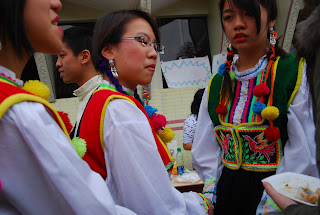 (Photo caption: First-generation students at the Chinese-Peruvian school "Diez de Octubre" prepare for a national Peruvian dance. Most can speak Cantonese in addition to Spanish.)
Roxana has a son, Jose, who was born in Peru the same year I was. Although he grew up in the Barrio Chino and both his parents were Chinese, he can only understand some basic Cantonese and admits to feeling far more Peruvian than Chinese. Even though he attended a Chinese-Peruvian elementary and secondary school, Jose tells me that he found the Chinese kids to often be cold and uninviting, whereas the Peruvians were much were carinoso, or warm-hearted.
 (Jose in his room in Barrio Chino.)
In contrast to the tusan Peruvian-Chinese (those born in Peru), though, recent immigrants feel no such love for Peru. Many recent Chinese immigrants see Peru as little more than a place to make money before returning to China. Others see Peru as simply a gateway to the U.S. or wealthier Western countries. A group of teenagers at a Peruvian-Chinese school admitted that they understood little Spanish and would return to China once their family had enough money. All of them have told me they lived in the countryside, and moved to Peru because of poverty. China remains their homeland, and although I haven't detected any particularly strong sense of nationalism, it seems as if there does exist a sense of Chinese cultural superiority.
 (Ping-pong tournament at Juan XXIII, the other Chinese-Peruvian school. Juan XXIII was originally founded by an Italian missionary who worked in China during the 1930s and 1940s. After China became ruled by the Communists in 1949, he apparently went back to Rome and asked the pope what he should do, mentioning the fact that he wanted to work with Chinese people. The pope sent him to Peru, with its substantial Chinese population.)
Like their North-American counterparts, however, Peruvian-Chinese do not necessarily have to choose between a Peruvian identity and a Chinese one. The descendants of the first Chinese immigrants here are proud of their hybrid identity. Doctor Luis Yong, the owner of a successful chifa restaurant in El Barrio Chino, director of the Associacion Peruana-China, and a surgeon, was emphatic in explaining to me the success story of Peru's Chinese immigrants. For him, the Chinese-Peruvians succeeded because of a cultural propensity toward hard work, integrity, respect, filial piety, and other guiding principles rooted in Confucianism and Daoism (and to a lesser extent, he says, in Buddhism... he seems to think that because Buddhism was not natively Chinese, it does not hold as large of an influence). The Chinese-Peruvians are distinguished from their Japanese-Peruvian, Italian-Peruvian, or Arab-Peruvian counterparts because they have both successfully managed to integrate into Peruvian society (Luis notes the hybrid chifa food), while also maintaining a strong cultural background. There is no Japantown, Little Italy, Luis says, perhaps idealizing the Chinese community.
Nationalism is often capable of clearing the identity slates of first-generation immigrants such as myself or Jose. First-generation populations, have far more malleable identities than their immigrant parents. Whereas immigrant parents have often seen Peru as simply a foreign land of opportunity, many first-generation children have adopted new national identities, and perhaps only secondarily bothered to consider their family's cultural heritage. Striking a balance between a cultural heritage and an adopted national identity is not impossible, but often induces false or simplistic ideals of nationalism or cultural superiority.
 (Photo caption: Onlookers at the Gran Curso Wong)
I've always found nationalism interesting; nationalism seems to inspire all sorts of emotions. One popular idea of nationalism holds that nations are "imagined communities," wherein nations are socially constructed community in order to define a national identity and create a sense of belonging among its citizens. Whereas "real" communities are often based upon kinships or small geographic boundaries, imagined communities must often construct identities in order to delineate a nation. Nationalism in Peru appear to be quite strong: the soft drink "Inca Kola" continues to outpace Coca-Cola (one of the few local beverages in the world to do so), people everywhere wear little lapels with the Peruvian flag, and as I mentioned in an earlier post, street names have all been renamed to more patriotic-sounding names, "Calle Wilson" became "Inca Garcilazo" (anything with "Inca" carries clear nationalistic connotations) "Jose Leuro" became "28 de Julio" (the day of independence), "Geldres" became "Libertad" (Liberty). It almost seems 1984-esque.
So how does this all relate to Chinatowns and the diaspora? Well, it occurred to me that I had largely considered myself first and foremost an American, and as a kid I enjoyed participating in activities celebrating a national pastime. I joined a fife and drum corps in fourth grade and felt proud to be celebrating my nation's heritage, which despite the fact that my parents were immigrants to the U.S., I saw as my own heritage. I memorized all the presidents' names and years, learned about the various wars the U.S. had fought, and was proud to be from Concord, Massachusetts, where the American war for independence had begun. I was bored by Chinese school and took little interest in learning about my family history (which I now know to be objectively, quite fascinating...).
I shouldn't be surprised, then, by the fact that most kids and teenagers of Chinese descent I've interviewed here know little about their Chinese familial history, seem bored by the required Mandarin classes, care little for anything Chinese (except the hongbao, or "red envelopes" stuffed with cash that Chinese kids receive during Chinese New Years), and consider themselves proudly Peruvian. And it shouldn't be surprising that Peruvians, regardless of whether they are white, mestizo, black, Chinese, or anything else can still dress up in "traditional Peruvian" costumes (often of Incan, pre-Incan, or pre-Spanish origin) and celebrate a national heritage. But I still have trouble getting over this embarrassingly obvious fact.
 (Photo caption: First-generation students at the Chinese-Peruvian school "Diez de Octubre" prepare for a national Peruvian dance. Most can speak Cantonese in addition to Spanish.)
Roxana has a son, Jose, who was born in Peru the same year I was. Although he grew up in the Barrio Chino and both his parents were Chinese, he can only understand some basic Cantonese and admits to feeling far more Peruvian than Chinese. Even though he attended a Chinese-Peruvian elementary and secondary school, Jose tells me that he found the Chinese kids to often be cold and uninviting, whereas the Peruvians were much were carinoso, or warm-hearted.
 (Jose in his room in Barrio Chino.)
In contrast to the tusan Peruvian-Chinese (those born in Peru), though, recent immigrants feel no such love for Peru. Many recent Chinese immigrants see Peru as little more than a place to make money before returning to China. Others see Peru as simply a gateway to the U.S. or wealthier Western countries. A group of teenagers at a Peruvian-Chinese school admitted that they understood little Spanish and would return to China once their family had enough money. All of them have told me they lived in the countryside, and moved to Peru because of poverty. China remains their homeland, and although I haven't detected any particularly strong sense of nationalism, it seems as if there does exist a sense of Chinese cultural superiority.
 (Ping-pong tournament at Juan XXIII, the other Chinese-Peruvian school. Juan XXIII was originally founded by an Italian missionary who worked in China during the 1930s and 1940s. After China became ruled by the Communists in 1949, he apparently went back to Rome and asked the pope what he should do, mentioning the fact that he wanted to work with Chinese people. The pope sent him to Peru, with its substantial Chinese population.)
Like their North-American counterparts, however, Peruvian-Chinese do not necessarily have to choose between a Peruvian identity and a Chinese one. The descendants of the first Chinese immigrants here are proud of their hybrid identity. Doctor Luis Yong, the owner of a successful chifa restaurant in El Barrio Chino, director of the Associacion Peruana-China, and a surgeon, was emphatic in explaining to me the success story of Peru's Chinese immigrants. For him, the Chinese-Peruvians succeeded because of a cultural propensity toward hard work, integrity, respect, filial piety, and other guiding principles rooted in Confucianism and Daoism (and to a lesser extent, he says, in Buddhism... he seems to think that because Buddhism was not natively Chinese, it does not hold as large of an influence). The Chinese-Peruvians are distinguished from their Japanese-Peruvian, Italian-Peruvian, or Arab-Peruvian counterparts because they have both successfully managed to integrate into Peruvian society (Luis notes the hybrid chifa food), while also maintaining a strong cultural background. There is no Japantown, Little Italy, Luis says, perhaps idealizing the Chinese community.
Nationalism is often capable of clearing the identity slates of first-generation immigrants such as myself or Jose. First-generation populations, have far more malleable identities than their immigrant parents. Whereas immigrant parents have often seen Peru as simply a foreign land of opportunity, many first-generation children have adopted new national identities, and perhaps only secondarily bothered to consider their family's cultural heritage. Striking a balance between a cultural heritage and an adopted national identity is not impossible, but often induces false or simplistic ideals of nationalism or cultural superiority.
Friday, July 11, 2008
Photos from China, 1917-1932
Duke University has just put online a great collection of photos taken by Sidney Gamble in China between 1917-1932. Although this is not related to my project, it's quite an extraordinarily collection.
http://library.duke.edu/digitalcollections/gamble/
http://library.duke.edu/digitalcollections/gamble/
Subscribe to:
Posts (Atom)
